
Aix-en-Provence – September 14, 2026 – smartTrade Technologies, the global leader in AI-powered multi-asset electronic trading and payments solutions, today announced the launch of smartTrade Flow, a comprehensive post-trade platform that takes trades from front-office execution through middle-office controls to back-office fulfillment. Flow covers matching, reconciliation, risk and position tracking, accounting, settlement, regulatory reporting and audit in one application, across asset classes including FX, precious metals, money markets, fixed income, crypto and derivatives.
Flow is a standalone product. It connects to existing trading platforms via API, and natively to LiquidityFX (LFX) and Commercial Banking & Payments (CBP) within the smartTrade ecosystem, so trades pass from the client’s execution platform directly into post-trade processing. For institutions on LiquidityFX or CBP, trading, payments and post-trade operations then come from one vendor, on one platform. smartTrade brings the automation, low latency, analytics and advanced processing for which it is recognized in trading and payments to post-trade operations.
“Our clients trust technology for their trading and payments workflows. But what happens after the trade is often where inefficiencies, breaks and errors occur, costing both time and money. smartTrade has brought a new solution to market to address these challenges,” said David Vincent, CEO and Co-Founder of smartTrade Technologies. “Flow takes executed trades and payments through matching, reconciliation, accounting, settlement and reporting, delivering a more efficient post-trade service, saving money, reducing risk, and helping banks to grow market share.”
The Problems Flow Solves
Post-trade has been left behind by two decades of front-office modernization. Flow is built to fix the specific failures that operations, finance, and audit teams live with every day:
- Breaks are found too late. Matching and reconciliation still run overnight, in batch or in spreadsheets, so exceptions surface after settlement. Flow matches executed trades and cash flows from every connected source and reconciles them in real time against external account and transaction data via SWIFT, CLS and API—recording investigation outcomes so the same break is never worked twice.
- Cash and risk are only known at the end of day. Nostro and Vostro balances, limits, positions and P&L sit in separate systems. Flow tracks them in real time, forecasts balances, warns of impending breaches, identifies potential settlement breaks, and recognizes P&L as it happens.
- Settlement is handled by hand. Client and inter-bank payments move through email, queues and manual approvals. Flow provides configurable settlement queues, inbound and outbound, with screening, funding, repair, approval, and investigation under full controls and tracking.
- Reporting and audit are an afterthought. Regulatory submissions are assembled across tools, and auditors ask for exports. Flow produces audit, control, credit, reconciliation, P&L, position and regulatory reports, submits EMIR, MiFID II, DTCC and other formats directly to trade repositories, and records every user and system action in real time.
- Every change needs a developer. A new matching rule or workflow waits on IT. Flow puts matching rules, reconciliation runs, queue movements, and maker-checker requirements in the hands of entitled business users, with configurable dashboards and notifications—on-platform, by email, and through Microsoft Teams—so key events are seen immediately.
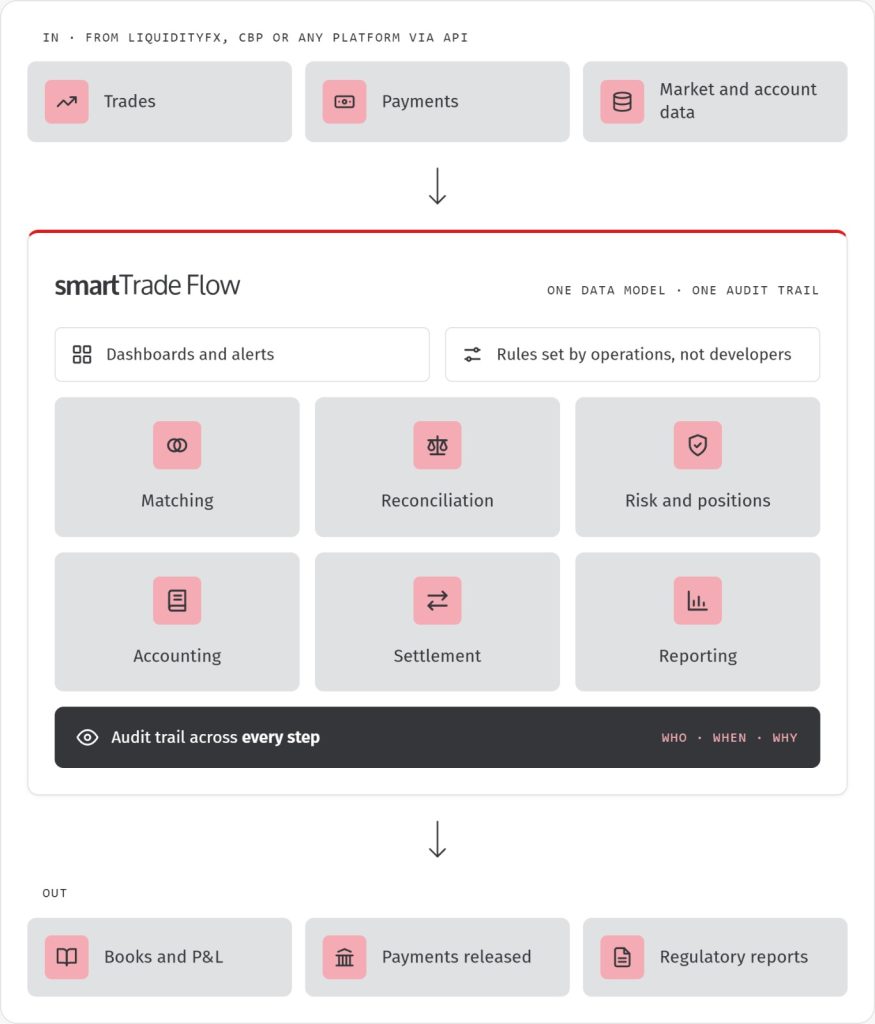
smartTrade Flow: trades, payments and account data in; books and P&L, payments released and regulatory reports out; one audit trail across every step.
Part of the smartTrade Ecosystem
Flow is a standalone product that also operates within the smartTrade ecosystem. LiquidityFX provides trading; Commercial Banking & Payments provides trading and payments; Flow completes the lifecycle with post-trade operations. A trade executed on LFX or a payment released on CBP passes directly into Flow without re-keying or a second vendor, and smartTrade Agentic Copilot (STAC) extends across all three—surfacing what needs attention and explaining any transaction on demand. Institutions running execution elsewhere connect Flow to their existing platforms via API.
smartTrade Flow is available to clients now and is being demonstrated for the first time at TradeTech FX Europe, Mövenpick Hotel Amsterdam, September 15–17, 2026.
For more insights on smartTrade’s AI-powered trading, payments and post-trade ecosystem, please visit smart-trade.net.
About smartTrade Technologies:
smartTrade Technologies is a global leader in AI-driven solutions for multi-asset electronic trading and payments. Headquartered in France, smartTrade provides agile, end-to-end platforms for financial institutions, specializing in FX, Precious Metals, Money Markets, Fixed Income, Crypto, and Derivatives, all delivered via a secure SaaS model. Key solutions include:
- LiquidityFX (LFX): A comprehensive end-to-end trading solution providing modules for connectivity to liquidity providers and venues, aggregation, smart order routing (SOR), order management (OMS), pricing, distribution, risk management, proprietary code hosting (AlgoBox), and analytics.
- Commercial Banking & Payments (CBP): Unites FX and payments capabilities across the entire lifecycle, enabling banks to offer integrated cross-border payment experiences. Features include tailored pricing and distribution, support for various payment types, cash management tools, ISO 20022 compliance, and flexible API integration.
- FX Derivatives (FXD) – previously operating under the kACE / Fenics name: A market-leading solution for FX and interest rate derivatives pricing, analytics, and risk management. FXD provides sophisticated tools for the entire options lifecycle, including structured product pricing, volatility analysis, and 3D scenario risk modeling, enabling institutions to automate complex derivatives workflows.
smartTrade is at the forefront of financial technology, leveraging smartTrade’s Agentic Copilot (STAC), to drive autonomous workflow optimization, ultra-low latency execution, and secure, scalable environments.