
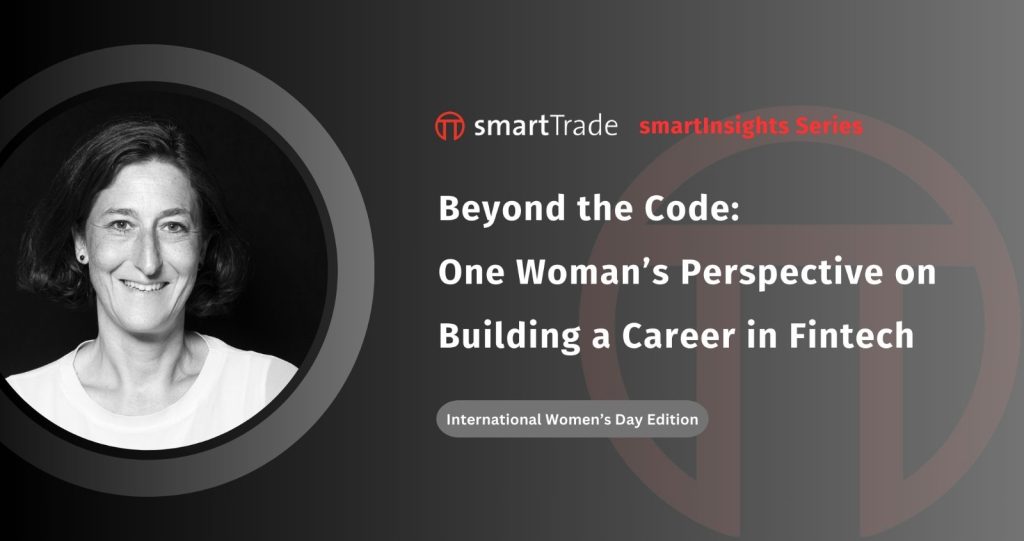
To mark International Women’s Day, smartTrade’s Chief Human Resources Officer, Elise Van Der Schans, sat down with John Stead to talk honestly about what draws women into tech, what holds them back, and what all of us — men included — can do differently.
Tech wasn’t the plan. But it turned out to be the perfect fit.
Elise Van Der Schans didn’t set out to build a career in technology. Her first role in the industry — at software company Sage — was, in her own words, “pure chance.” But it didn’t take long for her to realise she’d found her people.
“I really like both the analytical and the qualitative,” she explains. “In tech, you meet smart people who can take one complex problem and break it into smaller, manageable pieces. I found that genuinely inspiring.”
Add to that the relentless pace of an industry where what you learn today may already be outdated tomorrow, and it’s easy to see why she stayed. “You always need to keep improving, keep up with the changes. I like that challenge.”
“Tech is so much more than coding.”
If there’s one message Elise wants young women — and girls still in school — to hear, it’s this: the image of a programmer hunched over a screen is not what the industry actually looks like.
“Tech is cyber security, it’s product, it’s strategy, it’s operations. People should look beyond the code.” At smartTrade alone, the teams building and delivering world-class trading technology include sales, pre-sales, marketing, HR, and more — all orbiting a fast-moving, intellectually demanding core.
And AI, she argues, is accelerating this shift in a way that should genuinely excite women who’ve felt the industry wasn’t for them. “With AI, coding is no longer the barrier it once was. Everyone can build now. What becomes more important is the ability to think — to have ideas, to be curious, to be creative. And those qualities have no gender.”
Her advice to any young woman unsure whether tech is for her? “Curiosity and creativity are the real entry ticket. And everyone has those.”
Are there any figures in business or finance who have inspired you?
For Elise, one name stands out: Christine Lagarde, currently President of the European Central Bank and formerly the first woman to lead the International Monetary Fund.
“She has done a lot of things and dared to talk about difficulties,” Elise says. “That’s very inspiring.”
It’s not hard to see why. Lagarde has spent her career not just breaking barriers but naming them openly — acknowledging that women in leadership tend to over-prepare and over-anticipate precisely because, as the minority, they feel constant pressure to prove their worth. Her advice to women navigating male-dominated environments has been characteristically direct: grit your teeth and smile — in the face of adversity, go.
For Elise, it’s that willingness to speak honestly about the challenges — rather than pretend they don’t exist — that makes Lagarde a genuinely useful role model.
The double standard no one talks about enough.
Elise is candid about one of the subtler barriers women face — not in capability, but in how confidence is perceived and communicated.
“Every hiring manager will tell you they hire on competencies. But a woman might say ‘I’m good at this’ while a man says ‘I’m very good at this.’ The competency is the same. The way it’s communicated isn’t — and that gap is real.”
Her pragmatic advice to women navigating this? “Prepare. Practise your pitch with a friend, a mentor, or your father. Don’t be too modest. You don’t need to pretend to be someone you’re not — but understand the room, and make sure your confidence comes through clearly.”
A message for the men in the room.
Elise doesn’t let male colleagues off the hook — but she’s thoughtful rather than combative about it.
“The first thing I’d say is: accept that you are biased. We all are. It’s human. But once you’re aware of it, you can start to correct for it.” She’s seen this play out repeatedly in recruitment, where the same quality presented differently leads to very different outcomes.
She also shared an approach she encountered at an executive programme that stayed with her: rather than hiring role by role, companies that want more diversity should consider reviewing all open positions together, with all hiring managers in the room at the same time. “When you isolate hiring decisions, you isolate women from the process without even realising it. Broadening the exercise changes the outcome.”
And for those who still need a simple compass? “Think about your daughter. Think about how you’d want her to be judged when she walks into an interview. Then apply that standard today — to every candidate, every time.”
smartTrade Technologies is committed to building an inclusive and diverse workplace. To find out more about our culture and open roles, visit https://career.smart-trade.net/jobs.